
The Mohs procedure was developed to allow a dermatologic surgeon to perform surgery on skin cancer and have a greater certainty that the tumor has been completely removed. Mohs surgeons are Board Certified Dermatologists who have undergone additional training in the Mohs surgery technique.
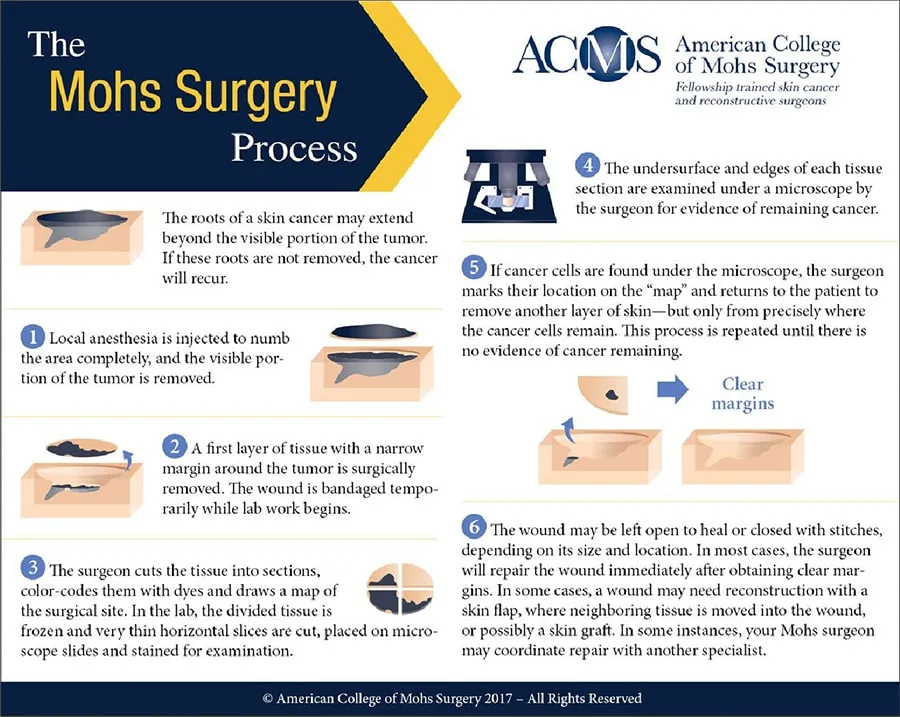
Skin cancers grow like icebergs; there is more below the surface than can be seen on the skin surface. If only the visible tumor is removed cancer cells can get left behind. With Mohs surgery, we cut around the cancer and examine all edges under the microscope to make sure all of the abnormal cells are removed. If remaining cancer is seen, we will remove additional skin but only from the area with the cancer. In this way, the surgeon will remove all remaining tumor while leaving the normal intact. Mohs surgery provides a 99% cure rate for most skin cancers. It has the lowest recurrence rates, highest cure rates, and best cosmetic results of any skin cancer treatment currently available.
Most patients undergoing Mohs surgery have a common type of skin cancer, basal cell carcinoma (BCC) or squamous cell carcinoma (SCC). Mohs is usually recommended when a BCC or SCC is aggressive or large, appears in an area with little tissue beneath it (i.e. eyelid, nose, ear, scalp, genitals hand, or foot), or was treated and skin cancer has returned. There are some other rare forms of skin cancer where Mohs may also be indicated. The diagram below shows the process of Mohs surgery:
- Take all your medications as you normally do. You should stop supplements i.e., vitamins, fish oil, garlic one week prior to surgery.
- You do not need to stop blood thinners.
- You may eat a normal breakfast on the morning of surgery. If your surgery is in the afternoon, please eat lunch.
- We recommend you have a support person drive you to and from the office. A support person is not required unless the patient is impaired or may need assistance. They may remain with you during most of the day. There will be only short periods where your support person will be asked to wait in the waiting room.
- Please do not bring children to the office.
- If you are a smoker, try to stop smoking 1 week before surgery and for 2 weeks afterward as smoking impedes healing.
- If the procedure will be on your face please come with a clean face and do not wear make-up.
- Be sure to shower and wash your hair prior to your appointment as you will not be able to get the surgical area wet for 48 hours following the procedure.
- Wear loose comfortable clothing.
What To Expect On The Day Of Surgery
Please arrive 15 minutes before your appointment. Be prepared to spend the entire day with us as we cannot predict how long your surgery will take. You are welcome to have a friend or family member come to your appointment with you.
- After checking in, our nurse or medical assistant will take you to one of the procedure rooms and review your medical history, current medications, and allergies.
- You will be asked to sign a consent form that will give us your permission to perform the procedure and take photographs.
- We will take a close-up photograph of the area where the procedure will be performed.
- Your skin will be cleansed with alcohol and then numbed with an injection of Lidocaine anesthetic. This may burn and sting for a few seconds, but the area will become numb quickly. We will take every step to make the procedure as painless as possible.
- The first step of Mohs surgery is to try to determine the extent of the tumor under the skin.
- Then the first layer of skin is removed with a scalpel; any bleeding is stopped.
- The nurse or medical assistant will bandage the wound and we will show you back to the waiting room or have you wait in your surgery room.
- The removed tissue is taken to our lab to be processed and will be looked at under the microscope to see if the cancer is removed. This process takes approximately 90 minutes.
- When the tissue is ready, the doctor examines it under the microscope. If there is any tumor remaining we will mark that area on a map. We use the map to tell us where the tumor remains on your skin.
- Back in the procedure room, we will remove the dressing and inject more local anesthetic (Lidocaine). The doctor will excise additional skin from the area where the cancer is still present; the process is then repeated as above.
- The average number of these stages that need to be taken is two.
- Once the cancer is completely removed we will take another photograph of the wound and discuss the repair.
We will explain the methods of closure with you which we think will give the best result. Once wounds are healed and the stitches taken out, the scar will continue to heal and develop over the next 6-12 months. Sometimes a second procedure is needed to help the scar be less noticeable. This is typically done between 4 to 8 weeks after the surgery. This can include injections of anti-scarring medication or laser procedures.
After the wound is closed, we will make you an appointment to be seen for follow-up, if necessary. You will have a bandage in place. We will give you detailed written post-op care instructions and phone numbers to call if you have questions or concerns. To give yourself the best chance of healing well we strongly advise you to follow the written wound care instructions. Typically, most wounds are not painful after surgery. If there is discomfort you may take an acetaminophen. Your referring doctor will receive a letter and surgery notes from Dr. Hajar.
Most of the skin cancers have roots under the skin that can not be seen with the naked eye. The biopsy is performed to sample the tumor, not to remove the entire tumor. Even though the surface of the skin has healed there is still a tumor underneath.
Depending on how concerning the tumor is, many cases can be delayed 4-6 weeks without problems. We will address your scheduling concerns with you. Please do not schedule your surgery close to a vacation, travel for work, an important event, or a time when you will not be available for us to see you for follow-up. If the surgery will be on your face, please do not schedule near a time that you will be expected to be in photographs such as a wedding, reunion, or graduation.
You may remove the white pressure dressing and tape after 48 hours. Please leave the flesh-colored Steri-Strips in place until they fall off. The Steri-Strips will start to curl up around the edges and you may trim them flush with the skin with some clean scissors. Please leave the Steri-Strips on as long as possible to assist with wound closure.
You may shower 48 hours after surgery after the white pressure dressing has been removed. Please do not allow the shower water to hit the surgical site directly. Soap and water running over the Steri-Strips and surgical site are fine.
We recommend you limit vigorous physical activity, excessive bending over, or exercise for 7 days after your Mohs surgery. This will allow your wound to heal and prevent bleeding or damage. Functionality may be affected, for example, if the surgery takes place on your hand, your ability to do manual work will be negatively affected.
You should plan on avoiding exercise for a full 2 weeks after surgery. If your surgery is on your lower legs, Dr. Hajar may recommend avoiding exercise longer. You may go for short walks gradually working up to moderate walking. You should avoid yoga, weightlifting, and aerobic exercise for the full 2 weeks or the amount of time recommended by Dr. Hajar.
Basal cell carcinoma, Squamous cell carcinoma, and Melanoma are all completely different types of cancer. One does not become the other. Each has early stages and more advanced stages of the disease, but they are still their own cancers. Basal cell carcinoma and squamous cell carcinoma should not be confused with malignant melanoma.
There are rare instances where a biopsy may cure a cancer but by far the majority of tumors are not removed by the biopsy. If left alone the cancer will continue to grow. Basal cell carcinoma rarely spreads to other parts of the body, it keeps growing locally becoming destructive to the skin and surrounding tissues. Squamous cell carcinoma does have a risk of spreading to other body parts. The longer the tumor is left the more the risk increases.
Studies show that about 4 out of 10 people (40%) will get another skin cancer in the next 2 to 4 years. Once you have had your surgery we recommend regular skin checks by your dermatologist. Initially, skin checks should be done every 6 months, and if no other tumors are found, then usually once a year. People with a history of multiple skin cancers should be seen more often. Frequent skin checks will allow for identifying tumors at an early stage so they are smaller and easier to treat.
A Mohs surgeon is a board-certified dermatologist who has undergone intense training in skin cancer surgery after completion of their residency program. Only fellowship-trained Mohs surgeons may become members of The American College of Mohs Surgery. This is the only organization that requires its physician members who have completed residency, to successfully complete an additional specialized Mohs surgery fellowship which involves at least one year of extensive surgical training in the Mohs procedure, skin cancer pathology, and surgical reconstruction.
Some tumors on the face can require larger bandages on the first day that may interfere with vision or wearing glasses. Patients may feel quite tired after having surgery and for both reasons it is safer to have a driver. A driver or support person is not required but should be considered based on individual needs or circumstances.
Mohs surgery is not appropriate for all types of skin cancer and there are alternative options for treating skin cancers. The decision to use Mohs depends on a number of factors relating to the cancer, the location, size, unique circumstances, and prior treatments used. Other methods we use for treating skin cancer include the following:
- Scraping & Burning (Curettage & Electrodesiccation: C&D) — this is often used on the trunk, arms, or legs where we have skin to spare, but the recurrence rate on other areas is higher and the scars tend to be wide. There is no pathology confirmation the tumor has been fully removed. Any recurrent tumor will be affected by scar tissue making it more difficult to remove using this method a second time.
- Simple Excision — When a lesion is excised, we use a standard margin, usually 4 mm around the tumor. A 4mm margin is usually fine when there is extra skin to spare. For the face and areas where the skin is very tight, we prefer to take more narrow margins. When the specimen is sent to the pathologists, they only examine a few sections through it, so the recurrence rates tend to be higher with simple excisions.
- Anti-Cancer Creams — There are creams that have been FDA-approved for many years and are being used to treat skin cancers. The concept of using a cream and avoiding surgery is very attractive. Creams must be used for several months at a time to work and they may cause skin irritation. Recent studies have shown that 1/3 of the tumors treated topically will recur over time. The creams do not penetrate very far into the skin, so deeper tumors are not appropriate to treat topically. Some tumors have scar tissue around themselves and this acts as a barrier to the cream. For these reasons, creams have been shown to be more effective for thin tumors.
skin cancer treatment portland, skin cancer surgeons, skin cancer reconstruction portland, best mohs surgeon near me, mohs surgery portland oregon, mohs surgeons near me, melanoma treatment portland, melanoma doctor portland, how long for mohs surgery to heal, mohs surgery on ear, skin cancer removal portland, mohs clinic, portland cancer treatment, skin cancer portland, mohs surgery near me, alternative to mohs surgery near me
What are the benefits of Mohs Surgery?
Mohs surgery offers the lowest recurrence rates, highest cure rates, and best cosmetic results of any skin cancer treatment currently available. By removing all remaining tumor while leaving the normal skin intact, Mohs surgery ensures that the cancer is completely eradicated.
Additionally, Mohs surgery is typically recommended for aggressive or large basal cell carcinoma (BCC) or squamous cell carcinoma (SCC), especially if the cancer appears in areas with little tissue beneath it. This precision in targeting the cancer while preserving as much healthy skin as possible sets Mohs surgery apart from other treatment options.
What can I expect during the recovery process after Mohs Surgery?
After Mohs surgery, the wound will be closed and you may experience some discomfort, but most patients find that the pain is manageable with over-the-counter pain medication. The healing process may take several weeks, during which time the scar will continue to improve and develop.
It is important to follow post-operative care instructions provided by your healthcare provider to ensure proper healing and minimize the risk of complications. You may be advised to limit physical activity, avoid certain medications, and keep the wound clean and protected during the recovery period.
skin cancer treatment portland, skin cancer surgeons, skin cancer reconstruction portland, best mohs surgeon near me, mohs surgery portland oregon, mohs surgeons near me, melanoma treatment portland, melanoma doctor portland, how long for mohs surgery to heal, mohs surgery on ear, skin cancer removal portland, mohs clinic, portland cancer treatment, skin cancer portland, mohs surgery near me, alternative to mohs surgery near me
What are the benefits of Mohs Surgery?
Mohs surgery offers the lowest recurrence rates, highest cure rates, and best cosmetic results of any skin cancer treatment currently available. By removing all remaining tumor while leaving the normal skin intact, Mohs surgery ensures that the cancer is completely eradicated.
Additionally, Mohs surgery is typically recommended for aggressive or large basal cell carcinoma (BCC) or squamous cell carcinoma (SCC), especially if the cancer appears in areas with little tissue beneath it. This precision in targeting the cancer while preserving as much healthy skin as possible sets Mohs surgery apart from other treatment options.
What can I expect during the recovery process after Mohs Surgery?
After Mohs surgery, the wound will be closed and you may experience some discomfort, but most patients find that the pain is manageable with over-the-counter pain medication. The healing process may take several weeks, during which time the scar will continue to improve and develop.
It is important to follow post-operative care instructions provided by your healthcare provider to ensure proper healing and minimize the risk of complications. You may be advised to limit physical activity, avoid certain medications, and keep the wound clean and protected during the recovery period.